
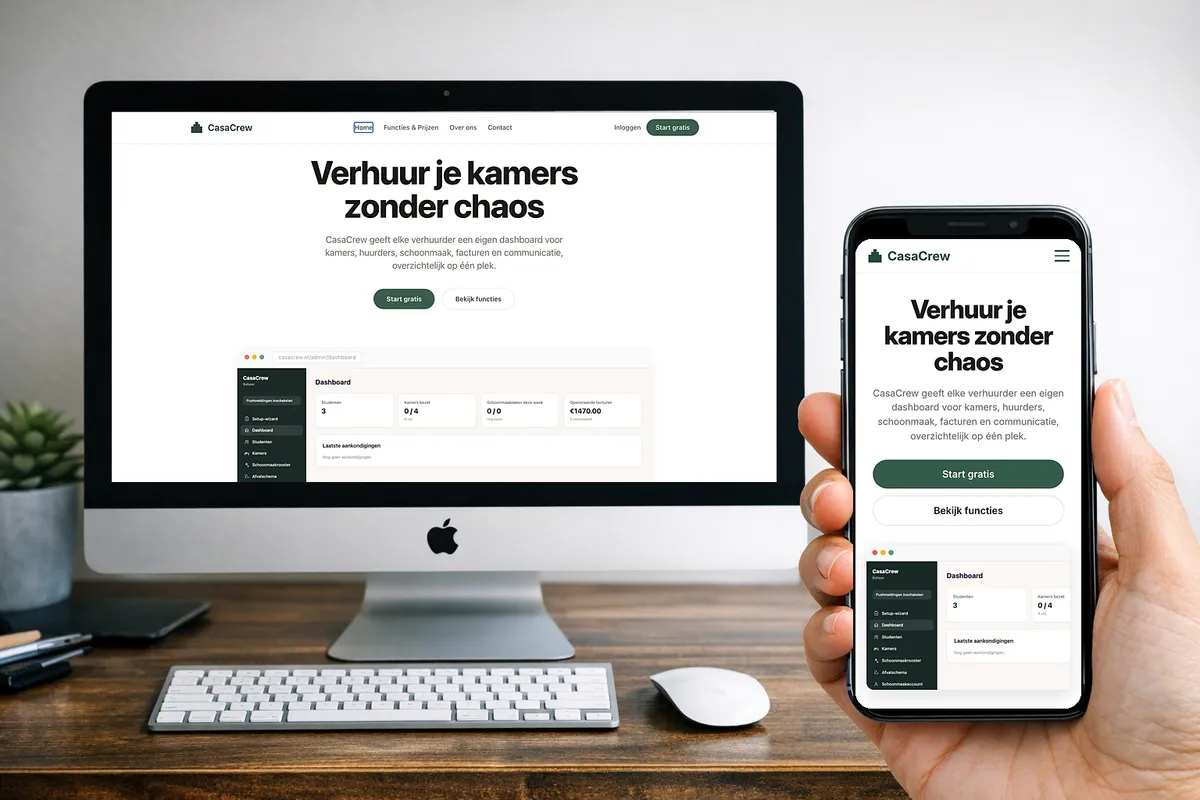
CasaCrew didn't start as an idea for an app. It started with a website for Villa Vredestein, and a question I asked when that website was almost finished.
First, the website
First came the request for a website for Villa Vredestein, a historic villa in Driebergen where rooms are rented to students. CasaCrew grew out of that. A few pages, was the idea. I kept asking about the house, its history and the people who live there. That became the website.
But during those conversations, something else came up. The renting itself. Who has paid? Which contract ends when? Whose turn is it to clean the bathroom this week? It was all in one spreadsheet. And that spreadsheet kept growing.
The real problem
A landlord renting out rooms does much more than rent out rooms. You are the bookkeeper, the planner, the landlord and sometimes the referee. The work isn't hard, but it is scattered. And scattered work takes time, especially when you have to piece it together again every month.
That doesn't call for expensive software with a hundred features you'll never use. It calls for something that does exactly what is needed, and nothing more.
What CasaCrew does
- An overview of all payments, with automatic reminders
- Digital contracts and house rules, always at hand
- A cleaning schedule per room, so nobody has to remember whose turn it is
- A personal account for every tenant
- Separate access for landlord and tenant: everyone only sees what is meant for them
The landlord later put it simply in a review:
"Then she also built a rental dashboard for our student rooms, complete with payments, contracts and a cleaning schedule, and suddenly I no longer had to curse an Excel sheet."
How I built it
For those who want to know, the technology in plain language:
- Spring Boot: the toolkit I build the app with. Think of it as the sturdy frame of a house.
- PostgreSQL: the database. A big cabinet with drawers where everything is kept neatly: tenants, payments and contracts.
- OAuth2: secure login. Like "log in with Google": nobody gets in without the right key.
- REST API: the waiter between what you see on screen and the kitchen behind it. You order, the waiter fetches it and brings it back.
Together that is a solid engine under the hood, so the app can grow along. From one house to ten, from five tenants to fifty.
I deliberately kept the design calm. A landlord opens the app in between other things. You want to see what's going on at a glance, not go looking for it.
What I learned
The best projects don't start with a brief, but with a question. Had I only done what I was asked, Villa Vredestein would have had a nice website and the landlord would still be stuck with a spreadsheet.
And what works for one landlord often works for others. That's why CasaCrew is now an app of its own, available to other landlords.
Do you rent out rooms?
Recognise that overflowing spreadsheet? See what the app can do at casacrew.nl, read more on the project page, or book a free intro call. I'll show you the app and we'll see together whether it fits your situation.